
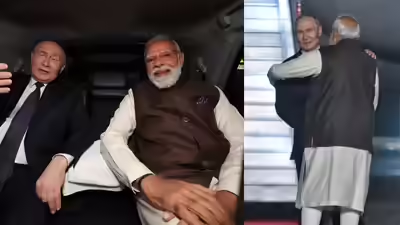
India Russia Trade: Putin’s Visit Creates Major Opportunity to Reduce Trade Deficit, Strengthen Make in India, and Expand High-Tech Cooperation
India Russia Trade: The upcoming visit of Russian President Vladimir Putin is being viewed as a significant moment for India–Russia economic relations. Trade between the two nations reached an impressive $63.6 billion last year, yet India’s exports were only $5.6 billion, highlighting a substantial trade deficit. The major driver of this growing trade volume has been India’s large-scale import of discounted Russian crude oil. As a result, trade expanded by nearly 12%, but the imbalance widened sharply.
Indian officials believe that new economic decisions expected during Putin’s visit may help rebalance bilateral trade, encourage greater market access for Indian products, and support India’s long-term manufacturing goals under the Make in India initiative. Additionally, the visit is likely to open doors for deeper collaboration in advanced technologies, including energy, defense, space, and digital innovation.
India Russia Trade: A Calculated Response to U.S. Pressure
India has been navigating increasing pressure from the United States, particularly after the U.S. imposed a 50% tariff on goods associated with Russian-origin oil. These tariffs had the potential to significantly impact India’s export economy. To counter this challenge, India strategically expanded its exports to European nations, the Middle East, and several emerging markets. This move helped reduce the impact of American trade restrictions.
Stronger cooperation with Russia, especially in sectors such as energy, manufacturing, and infrastructure, is expected to further cushion India against U.S. tariff-related disruptions. Russia’s role in this rebalancing process may prove crucial in ensuring India’s economic stability in the face of global political uncertainties.
India Russia Trade: A Broader Geopolitical Message to the West
Renowned strategic affairs expert Brahma Chellaney emphasizes that Putin’s visit should not be interpreted merely as a trip involving a few agreements. Instead, it reflects a broader geopolitical message. India continues to assert its right to conduct an independent foreign policy, rejecting the binary choices often presented by Western nations — the notion of being “with us or against us.”
Both nations understand that the current global landscape demands flexibility and cooperation. Russia, facing ongoing pressure and isolation from Western powers due to the Ukraine conflict, wants to show that it is not solely dependent on China for strategic and economic support. India, on the other hand, aims to reaffirm that it will continue to protect its strategic autonomy, maintaining balanced relations with all major global powers, including the U.S., Russia, and Europe.
India Russia Trade: A Timely Reply to U.S. Double Standards
Former Indian Foreign Secretary Kanwal Sibal notes that significant defense announcements may not be made publicly during this visit. However, he points out that defense cooperation between the two nations will continue to progress steadily behind the scenes.
Sibal also highlights the timing of the visit. Western countries have been criticizing India for not taking a stronger stance against Russia in the Ukraine war. However, he questions the double standards in such criticism. If U.S. President Donald Trump can welcome President Putin in Alaska with full diplomatic honor, then there is no justification for pressuring India to distance itself from Moscow.
Chellaney and other scholars agree that, at this moment, India and Russia both stand to benefit from strengthening their partnership. For Russia, it is an opportunity to diversify its strategic alliances beyond China. For India, it is a sign that it will maintain its sovereignty in foreign policy decisions regardless of global opinion.
Conclusion: India–Russia Trade
Putin’s visit comes at a time when the global economic and political environment is shifting rapidly. It provides India with a chance to narrow the trade deficit, expand opportunities for Make in India, and enhance cooperation in energy, defence, space, and emerging technologies. At the same time, the visit sends a powerful diplomatic message:
India will continue to follow its own path, strengthen partnerships based on national interest, and maintain strategic independence in a multipolar world.
News Source: Amar Ujala