
Operation Sindoor Briefing: India Strikes 100 km Inside Pakistan, Destroys Nine Major Terrorist Hideouts in Just 25 Minutes
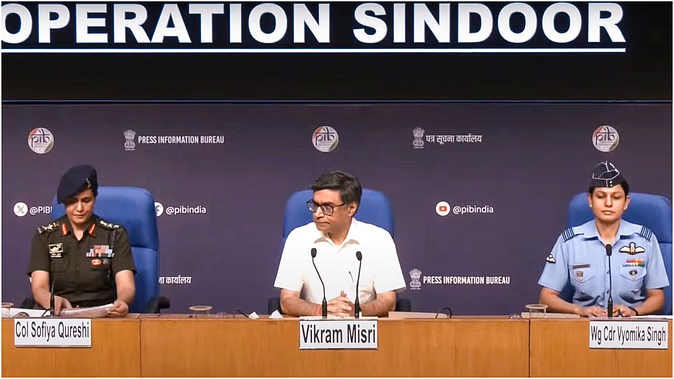
Indian Army Press Conference – Live Updates on Operation Sindoor
In a historic and decisive counter-terrorism move, the Indian Armed Forces carried out a precision strike deep inside Pakistan and Pakistan-occupied Kashmir (PoK), targeting and destroying major terrorist infrastructure. The operation, codenamed ‘Operation Sindoor,’ was a coordinated assault involving the Indian Army, Air Force, and Navy, and resulted in the destruction of nine key terrorist hideouts within a span of just 25 minutes. This included camps reportedly linked to internationally designated terrorist leaders Hafiz Saeed and Masood Azhar.
Targets were struck as far as 100 kilometers inside Pakistan, with specific locations identified as Muzaffarabad, Bahawalpur, Muridke, Sialkot, and Kotli. These sites were confirmed terrorist strongholds and launch pads for cross-border attacks. Out of the nine hideouts destroyed, five were in PoK and four were in mainland Pakistan.
Joint Military Action and Official Briefing
The government of India, in coordination with the defense forces, held an official press conference following the successful completion of the mission. The briefing was led by Foreign Secretary Vikram Misri, Colonel Sofia Qureshi, and Wing Commander Vyomika Singh, who provided comprehensive details on the planning, execution, and outcome of the strike.
It was revealed that Operation Sindoor was launched between 1:05 AM and 1:30 AM, a carefully chosen window to ensure precision and minimal risk to civilian life. The mission was conducted based on highly credible intelligence and focused exclusively on terrorist infrastructure. Strict instructions were followed to avoid civilian casualties and protect residential areas, reflecting India’s commitment to ethical military operations.
Justice for Pahalgam: The Catalyst Behind the Strike
Before delving into operational specifics, the press conference began with a chilling reminder of the Pahalgam terror attack that took place on April 22, 2025. Scenes from previous attacks — including the Parliament attack, the 26/11 Mumbai attacks, the Pulwama attack, and the most recent massacre in Pahalgam — were shown to provide context.
Foreign Secretary Vikram Misri began by saying,
“On April 22, 2025, Pakistan-trained terrorists from Lashkar-e-Taiba launched a brutal assault on a group of innocent tourists in Pahalgam, Kashmir. This horrifying attack claimed the lives of 25 Indian nationals and one foreign citizen. Victims were shot at point-blank range in front of their families — a deliberate act of terror meant to traumatize and send a disturbing message to the rest of the country.”
He further stated that the objective of the Pahalgam attack was to derail the peace process in Jammu and Kashmir, destabilize the rising tourism economy — which attracted over 75 million visitors last year — and incite communal violence across the region and beyond.
A little-known group, The Resistance Front (TRF), a front for the banned outfit Lashkar-e-Taiba, claimed responsibility for the attack. India had already informed the United Nations of the group’s connection to Pakistan’s terror ecosystem.
‘Measured Response’ Based on Intelligence and National Security Interests
Colonel Qureshi and Wing Commander Singh explained that the mission was designed as a targeted and proportionate response to the growing threat of cross-border terrorism. The nine hideouts destroyed were being used to train militants, store arms and ammunition, and serve as launching pads for terrorist infiltration into India.
They emphasized that Operation Sindoor was not a retaliatory gesture, but a preemptive strike grounded in India’s sovereign right to defend its citizens and prevent further bloodshed. “We acted on concrete intelligence inputs. Every target was chosen with precision and with careful planning to minimize collateral damage,” they stated.
Pakistan’s Continued Support to Terrorism Highlighted
In a powerful statement, Misri said,
“This attack is just another chapter in Pakistan’s long and bloody record of supporting cross-border terrorism. For decades, Pakistan has been a safe haven for global terrorists. Take the case of Sajid Mir, who was declared dead by Pakistani authorities, only to be found alive under international pressure. This is how terrorism thrives when perpetrators are protected instead of punished.”
He highlighted that despite repeated warnings and international pressure, Pakistan failed to take credible action against terror groups operating from its soil. In light of this, India had no option but to take proactive measures to eliminate immediate threats.
India Upholds Its Right to Defend Peace and Security
Foreign Secretary Misri concluded by stating that India exercised its right to self-defense under international law and the principles upheld by the United Nations Security Council. He reiterated that the operation was measured, legitimate, and focused solely on neutralizing active threats, and should be viewed within the global framework of counter-terrorism efforts.
He reminded the global community of the UNSC’s repeated calls to hold state sponsors of terrorism accountable, and urged countries to stand united against such acts that endanger regional and global peace.