
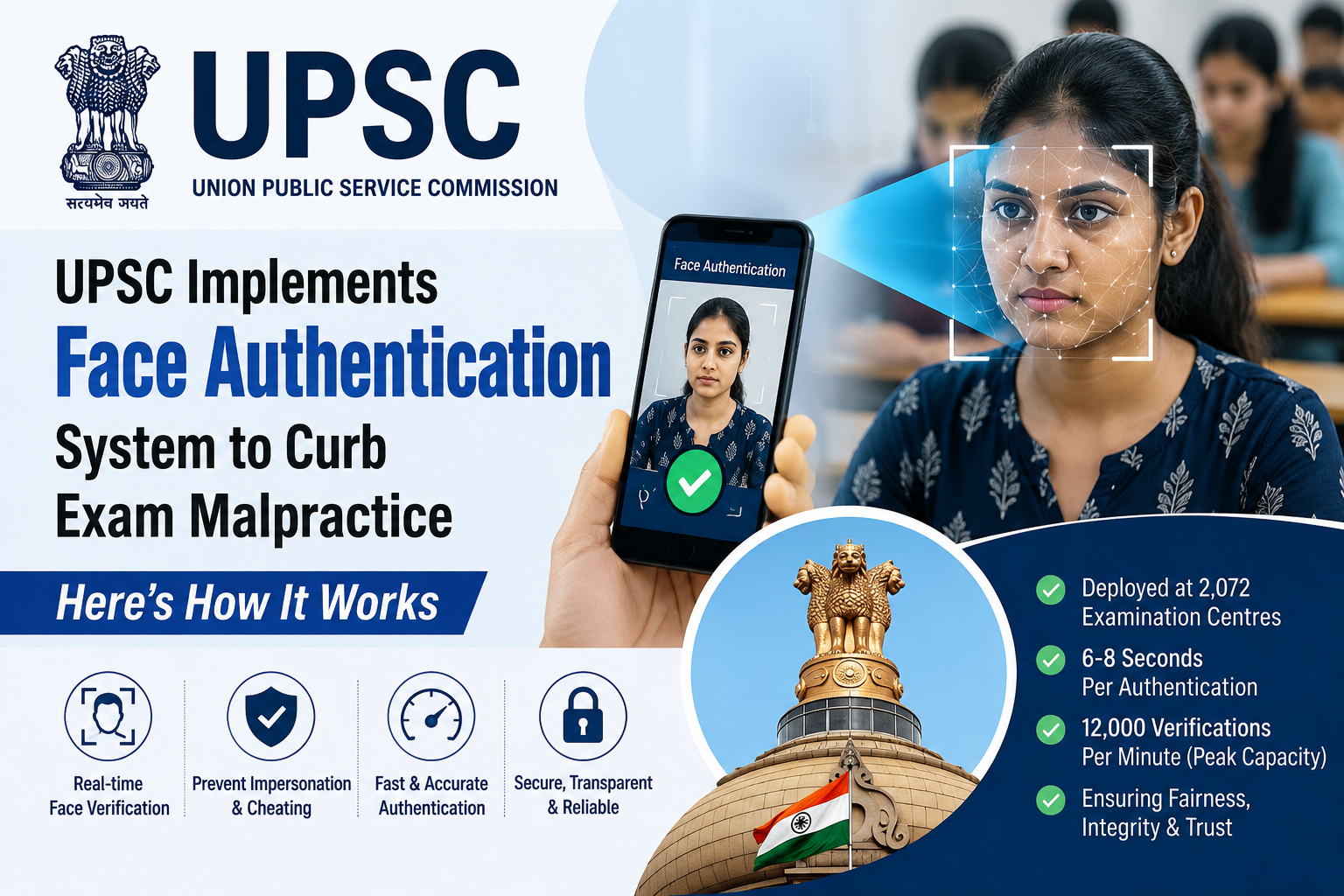
UPSC Face Authentication System: UPSC Implements Face Authentication System to Curb Exam Malpractice in Civil Services Exam 2026
The Union Public Service Commission (UPSC) has taken a major technological step forward by introducing a Face Authentication System in the Civil Services and Indian Forest Service (Preliminary) Examination 2026. The move is aimed at strengthening exam security, eliminating impersonation, and ensuring that only genuine candidates are allowed to appear in one of India’s most competitive examinations.
This initiative, widely referred to as the UPSC Face Authentication System to curb exam malpractice, marks a significant shift toward digital verification in large-scale government examinations.
What is UPSC Face Authentication System?
The newly implemented UPSC Face Authentication System is an advanced identity verification technology that matches a candidate’s live facial image with the photograph submitted during the application process.
Here’s how it works in simple terms:
- At the time of application, candidates upload their photograph.
- During the examination, a live photo is captured at the exam centre using a secure mobile-based system.
- The system instantly compares both images.
- Only when the facial match is successful is the candidate allowed to proceed into the examination hall.
This real-time verification ensures that the person sitting for the exam is exactly the same individual who registered, effectively preventing impersonation and fraudulent entries.
UPSC Implements Face Authentication System Across 2,072 Centres
For the Civil Services (Preliminary) Examination 2026 conducted on May 24, the UPSC Face Authentication System was deployed on a massive scale across 2,072 examination centres nationwide.
According to official data:
- Total applicants: 8,19,732 candidates
- Candidates who appeared: approximately 5.49 lakh (around 67%)
- Exam centres covered: 2,072 across India
The scale of this implementation highlights the UPSC’s commitment to ensuring transparency and fairness in the examination process.
How UPSC Face Authentication System Helps Prevent Malpractice
The primary objective of the UPSC Face Authentication System to curb exam malpractice is to eliminate cheating practices such as impersonation (fake candidates appearing in place of real ones).
The system strengthens exam integrity in several ways:
- Instant identity verification using live facial recognition
- Elimination of fake candidates before entering exam halls
- Reduced dependency on manual checking, which is often slow and error-prone
- Improved transparency in large-scale examinations
With this system, invigilators no longer rely only on admit cards or photo IDs. Instead, they use a mobile-based application that captures a candidate’s live image and verifies it within seconds.
Technology Behind UPSC Face Authentication System
The UPSC Face Authentication System has been developed in collaboration with the National e-Governance Division (NeGD) under the Ministry of Electronics and Information Technology (MeitY).
The system integrates modern biometric and AI-based facial recognition tools to ensure accuracy and speed. Once the live image is captured at the examination centre, it is instantly matched with the database image submitted during registration.
If the system detects a mismatch, the candidate is flagged for further verification, ensuring strict control over identity fraud.
Smooth and Large-Scale Implementation
One of the biggest achievements of the UPSC Face Authentication System implementation was its successful deployment across thousands of centres in a very short time frame.
Officials noted that executing such a large-scale digital identity verification system was a significant logistical challenge. It required:
- Rapid training of thousands of invigilators
- Deployment of mobile-based authentication tools
- Seamless coordination between UPSC, NeGD, and MeitY teams
- Ensuring uninterrupted exam operations across India
Despite these challenges, the system worked smoothly across all centres and successfully handled lakhs of candidates without disruption.
High-Speed and High-Capacity Verification System
A standout feature of the UPSC Face Authentication System to curb exam malpractice is its speed and scalability.
Key performance highlights include:
- Identity verification completed in just 6 to 8 seconds per candidate
- Overcrowding at entry points significantly reduced
- Capability to handle large-scale simultaneous verifications
- More than 7,000 invigilators using the system at once
- Peak processing capacity of nearly 12,000 verifications per minute
This high-speed processing ensured that candidates were not delayed at entry points and the examination process remained smooth and efficient.
A Major Step Toward Secure Digital Examinations
The introduction of the UPSC Face Authentication System represents a major milestone in modernizing India’s examination infrastructure. It reflects UPSC’s ongoing efforts to adopt secure, scalable, and technology-driven solutions for high-stakes competitive exams.
By integrating biometric verification into the Civil Services Examination process, UPSC has significantly strengthened trust in the fairness and transparency of the system.
Experts believe that this move could also serve as a model for other national-level examinations in India, promoting wider adoption of AI-based identity verification systems.
Conclusion
The UPSC Implements Face Authentication System to Curb Exam Malpractice initiative for the Civil Services and Indian Forest Service (Preliminary) Examination 2026 is a landmark step in exam security. With real-time facial verification, rapid processing, and large-scale deployment, the UPSC has set a new benchmark in preventing impersonation and ensuring merit-based selection.
As digital transformation continues to expand in governance, the UPSC Face Authentication System stands out as a strong example of how technology can safeguard the integrity of India’s most prestigious examinations.